Running in circles

Usually, to go/run in circles would indicate that although you are doing something, you’re not achieving anything. But with circuit running it is quite the opposite. You do achieve a lot!

What is it about running around the same loop – preferably not longer than a couple of kilometres – that I find so appealing? Gerry and I did the Dawn to Dusk 12-hour circuit race in 2008, and if memory serves me well, we finished second in the mixed pairs division totalling 116km or so. I absolutely loved it! It was a one kilometre figure-8 loop around a school athletics track and other sports facilities. We set up “camp” right next to the course (as did everybody else all along the circuit) and swapped over after every three kilometres. You could tag it as you pleased: some runners swapped over every 5km, others every 10km and so on. It was a really jolly affair with supporters, friends, family and runners, all around the circuit.

Three kilometres sounded logical to us as all races complying with ASA rules had to have a water point (with coke!) every three to four kilometres. And the benchmark was three kilometres, not four. So we were quite used to running three kilometres, then walk a short bit through the aid station, before continuing on. It turned out a good strategy for us and swapping the timing/counting chip over was luckily easy as.

I am quite frankly amazed that we haven’t sought out more of these types of events over the past few years, giving the fact that we really enjoy this sort of thing.

You may wonder what is so special about running in circles? Well, I don’t have a simple answer. Maybe it is the fact that you can just go into a Zen-like trance, not having to think about anything, being comfortably numb; maybe it’s the fact that you have your own support every kilometre or two (or three – whatever length of loop you choose to do); maybe it’s the sense of achievement you feel each time you can count down (or up) a loop; maybe it’s the fact that you’re never far from your car/help should the weather turn super nasty, or you need to bail for whatever reason; maybe it’s because you don’t have to run with a hydration pack, and can add or take off clothing layers as the weather changes? Who knows. But for me, it is also the fact that distance just somehow seems shorter if you break it down into one or two-kilometre distance laps. It almost feels like I can carry on forever.

Recently, Gerry and I had to fit in a long-run as training for an ultra and decided to run the Massey University 2km ring road until we reached 32km. So, only 16 laps around the loop and we’d be there. That’s not so hard, is it? Being 2km, meant we could potentially get water/sustenance every 2km, but we opted to refuel roughly every 4km. Since we also broke it up into running one lap, then walking one lap, that meant we only had to keep track of doing the same thing eight times. And that’s making running 32km really super-duper easy! One would think it is very hard to keep track of how many times you’ve been around the same short loop, but believe my, it’s not! Your mind ends up being occupied by just that – keeping track of your loops. And each one feels like a massive achievement.

Admittedly, I also started noticing things on the road, like a blue paperclip. And every time I stepped over it, I couldn’t wait to see it again. Because that would mean I’ve done another lap! On the less positive side of “landmarks”, there was a piece of gum in the road, which really annoyed me. Who would spit out such a nasty piece of sh*t in the road? It sticks to everything, pulling nasty strands of gooey stuff that also gets stuck to everything. Needless to say, every time I passed the gum, having to sidestep the blob, I was annoyed again. But luckily the blue paperclip was chirpy enough, reminding me of a happy little character.

Maybe I should stop rambling on in circles before risking sounding like a real lunatic! 🙂

Just give it a try – you too may be converted to the simple pleasures of running in circles!
North Range Road

Date: 29 August 2015

Distance: 25km

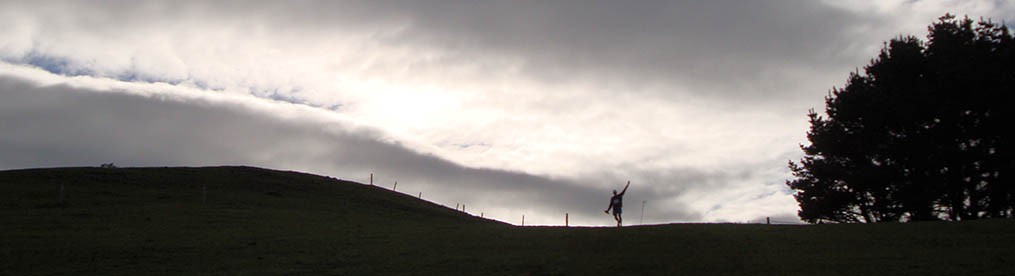
Having a quiet gravel road on top of a mountain with virtually no traffic, through a wind farm with wide open expanses, has to be the ultimate playing ground for runners, walkers and mountain bikers alike. Wonderful scenery in all directions, literally in our backyard, makes it hard not to want to run there all the time. Except, of course, on days with inclement weather. With views from the top of the Tararuas and great scenery in all directions, it is inevitable that you will be exposed to the elements. Continue reading

In it for the long haul – Manawatu Striders Winter Series

Date: 26 July 2015

Distance: 15km

Time: 1:39

The weekend long-run is probably the most important item in your weekly schedule on your way to fitness. Without the long-run, your endurance will not improve. Especially for okes like us who like to go far and long.

Not wanting to miss out on the Manawatu Strider’s Winter Series 15km event (which was too short for our build-up to the Taupo marathon), our only option was to fit in another few kilometres before the start of the Striders’ event. Wanting to cover about 30km, we could either do the course twice, or just do our own thing on a different path. We opted for the latter, and at about 7:30 in the morning we started out from the race start-and-finish area, heading out west through the Esplanade, past the swimming pool, turning onto the Bridle track at the Holiday Park, and ran all the way to the far end of the track and back to where we started. From the Holiday Park to the end of the track is 7.5km, so out and back is a nice 15km run. Continue reading

Hill (s)training

hills

Running hills are a pain in the butt for most of us and I’ll be damned if I would suddenly start doing hill repeats of any kind. In my world I have two choices: either make peace with walking all hills, always, or try to slowly trot to the top. Running hills, for me, is a contradiction in terms.

Admittedly I do walk most hills, especially the really steep ones. But as we know, hills make you strong so jogging up is definitely the better option. I will also acknowledge that the biggest gain in running hills is mental achievement, which in itself makes a massive difference in your perceived fitness levels.

As an average or slow runner, I’m as mentioned not in the market for hill repeats or hill training. I think you have to be able to run up a hill first before you can try to repeat it! If you can’t get up the blooming hill in the first place, how are you going to practise getting faster?

So here’s my 2cents worth of advice: the only way I can get myself up and over a hill is to just take it really really easy. Mimic the running action, but shorten your stride significantly. The aim is not to go out of breath or exert yourself to the point of no return. Use the same amount of effort as you would on the flat, keep your breathing and running rhythm the same, but progress s-l-o-w-l-y up the hill. When you get to the top, you should be able to continue running, while gradually increasing your stride length again to normal.

Hills should literally be taken in your stride. The confidence boost from getting to the top while still feeling okey, is phenomenal. Once you realise you can do it, hills are not so daunting and dreadful anymore. The key is to take it easy, really easy, even if it means running slower than what you could walk up a hill. The end result is you ran up the hill and didn’t succumb to walking. If you keep on doing this with every hill you encounter, it will automatically get easier! That I can vouch for, because hills are the necessary evil that makes you strong.

Now go out and tackle those hills head on with confidence. You can do it! 🙂


First time centurion – the Tarawera Ultra 100km

Date: 7 February 2015
Distance: 100km
Time: 17:25.54

All photos by us, except the ones containing the TUM logo which are courtesy of Photos4sale and TUM. 

Turns out writing about a 100km event is just as hard as doing it. What can you say that hasn’t already been said before? Instead of repeating what you can read about the race on the comprehensive official website, I thought perhaps I should just give a broad overview of my experience of the race weekend.

We drove through to Rotorua (the venue for the race) on the Thursday, two days prior to race day, figuring it might be a good idea before taking on our first 100km run to arrive well in time and settle down before the event. The official opening was quite early on the Friday morning, so even more reason to arrive the day before. After the official race welcome (Powhiri) at Te Aronui a Rua Marae, Te Puia, things moved to the Holiday Inn where registration, the expo, talks, presentations and all the rest took place. It was a jolly occasion, with lots of athletes and their support crews pitching up for the pre-race activities. There was even a rogaine on the Thursday that drew quite a number of participants.

One of the highlights of the proceedings during Friday morning was the keynote talk by Malcolm Law. He really is an extraordinary person, being the first to do the seven Great Walks in NZ in seven days to raise money for leukaemia and blood cancer. This time around he is pushing his limits even further by attempting to scale 50 peaks, and in the process run a total of 50 marathons, in 50 consecutive days, of which the Tarawera Ultra marked the start. Through his extraordinary High-5-O Challenge Malcolm aims to raise $400 000 for Mental Health (having lost a brother-in-law to suicide). One of the things he said that stuck with me, was that if you ever think of doing something, just do it. And that is so true. All the things that I’ve ever thought of doing, but haven’t yet, still taunts me every day (like that PhD!). Another excellent point he made was that if something cannot be scientifically proven to be impossible, then it must be possible. Definitely something to keep in mind next time you feel something is “impossible”. Continue reading